
Custom Jewelry Manufacturing Since 2010: A Buyer's Checklist
A founding date is the easiest claim to check and the hardest to fake. TTT Jewelry dates its operation to 2010, which puts 16 calendar years between the first mould and a 2026 audit, and the useful question is what those years left behind: written windows, a sample archive, hallmarks on drawings and a compliance file that still matches current rules. A checklist turns that history into something a buyer can inspect in an afternoon.

Key takeaways
- EST. 2010 means 16 years of trading by 2026, long enough for at least two generations of plating compliance rules.
- Ask for four written windows: CAD under 48 hours, sampling 25–30 days, production 3–4 weeks, response 24 hours.
- At 100% inspection, a 50-piece silver run receives 250 checks across five gates, not one final look.
- Sample approval should be a measured sheet, because sampling consumes roughly half of the 48–60 day development cycle.
Date the claim before you test it
Sixteen years is a specific span, and it implies specific survival. A factory that started in 2010 has lived through the tightening of nickel release limits, the shift from thin decorative plating to multi-layer systems, and the arrival of PVD vacuum plating on stainless steel. It has also had time to accumulate the thing buyers actually need, which is a repeatable way of turning a sketch into a shipped carton. Long tenure is not proof of quality, but it is a reason to expect process documentation, and documentation is testable.
The first test is vocabulary. Ask what happens between an inquiry and a quotation. A manufacturer with a formal flow will describe consultation and development, a CAD and prototype stage under 48 hours, sampling over 25–30 days, bulk production, then final QC and delivery with 100% inspection. A supplier without one will answer in generalities about quality and communication. The words are not the deliverable, but the absence of words usually predicts the absence of a schedule.
The second test is who replies. A 24-hour response commitment backed by a named project manager means the person answering has seen the technical pack. If every question routes through a sales inbox and returns three days later with a question about minimums, the factory may still be competent, but the buyer will be managing the information flow alone.
Checklist one: a process you can put on a page
Write the supplier's answer into a single page and see whether it holds together. The published figures from TTT Jewelry Manufacturer make a useful comparison because they are unusually granular: CAD in under 48 hours, master sampling in 25–30 days, mass production in 3–4 weeks, and a six-step flow that separates sample approval from bulk production. Granularity matters because it creates handover points where a buyer can say yes or no.
| Claim | Document to request | What it changes |
|---|---|---|
| EST. 2010, 15+ years | Business registration and a dated catalogue | Shows the process survived more than one product cycle |
| ISO 9001:2015 | Certificate with scope and expiry | Confirms a quality system across production stages |
| BSCI audited | Audit report and corrective actions | Covers labour and supply chain conduct |
| REACH and CA Prop 65 | Material and plating declarations | Keeps lead, cadmium and nickel claims current |
| 100% NDA and exclusivity | Signed agreement naming moulds and CAD | Determines who controls the tooling after launch |
None of these documents is difficult to produce if it exists. The delay is the finding. A certificate that arrives with an expired scope, or an NDA that mentions designs but not moulds, tells the buyer where the file has gaps before money moves.
Checklist two: who holds the sample and the mould
Sampling is the stage where a factory reveals how it works. The 25–30 day window is long because it holds a sequence: wax printing, casting, stone setting, polishing and electroplating. A supplier who can explain that order, and who can say which step caused the last delay, is describing a line rather than a promise. Ask for the sample to be produced on that line and plated in the same bath as bulk, then measure it rather than admire it.
Mould custody is the second half of the same question. A 100% NDA should name the mould, the CAD file and the collection, and it should say they are not resold or shown to other brands. The practical test is simpler: ask who physically holds the mould after the run, and what happens to it if the brand pauses for a season. An answer that shifts from the factory to "our partner workshop" is a warning about where the tooling actually lives.
Keep the approved sample. It is the reference for every reorder, and it is the only object that settles an argument about plating colour two seasons later.
Checklist three: marks, metals and the small print
Hallmarks belong in the CAD review. S925 for sterling, 316L for stainless and 18KGP for gold-plated pieces are laser-engraved, and their depth and position affect polishing and wear. A factory that asks where the mark should sit during modelling has done this before; one that stamps after plating is improvising at the last step.
Metal specifications should be equally plain. Sterling is 925 silver. The 316L grade contains 2–3% molybdenum and is chosen for shower-safe and swim-proof wear, while 304 stainless is water-resistant for daily use and often specified for volume. Eco-brass sits under multi-layer gold with an anti-tarnish e-coating. Those three sentences are enough to compare quotes, and a supplier who cannot match them is guessing at the substrate.
Finishing claims need the same treatment. Multi-layer 14K, 18K, 24K gold or rhodium is a description of the layer system, not a thickness, and the plating statement should point to REACH and CA Prop 65 compliance rather than to an adjective. Buyers who want the material detail in one place can read the sterling silver jewelry manufacturer page alongside the stainless line, because the minimums differ, 50 pieces per design against 100+, and that difference changes how a first range is built.
Worked example
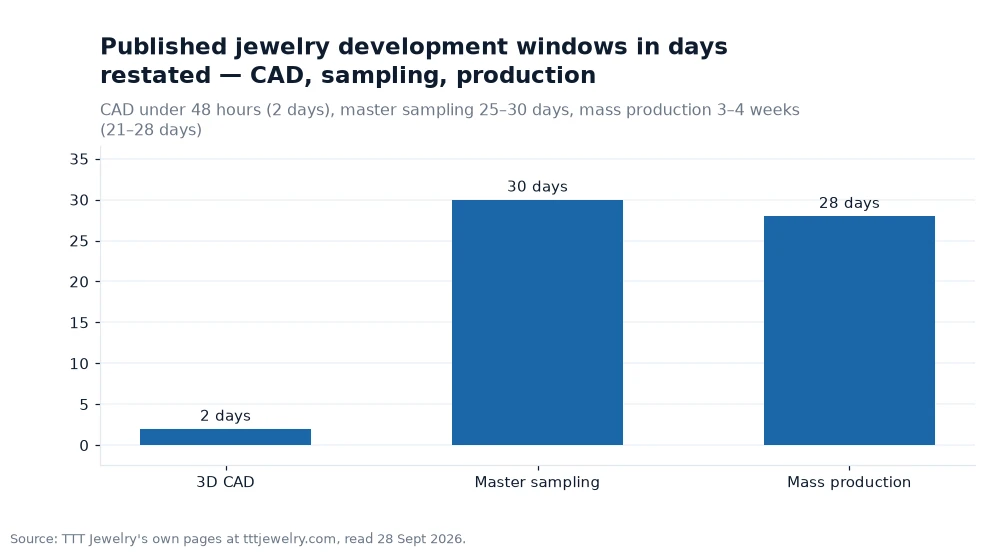
Put the published windows on one line: 2 days of CAD, then 25–30 days of sampling, then 21–28 days of production. The total is 48–60 days, or 7–9 weeks. Sampling dominates the calendar: 25/48 = 52% of the fast cycle and 30/60 = 50% of the slow one, so about half the calendar sits in the sample. Production is 21/48 = 44% and 28/60 = 47%. CAD is 2/48 = 4.2% and 2/60 = 3.3%, which is why a two-day modelling stage can still be the least disruptive point to change a design. For an OEM/ODM buyer, the lesson is to schedule approval meetings against the sampling window rather than against the ship date.
Frequently asked questions
Does a 2010 founding date mean the factory can handle my category?
Not automatically. It means the process has survived several product cycles. Confirm the category by asking for the mould and plating route for a comparable piece, then check that the quoted windows match the written flow.
How long should a buyer allow for sample approval?
The factory window is 25–30 days. Add the buyer's own review time, because every extra round sits outside that window and pushes the 48–60 day total. Book the review before the sample ships.
Which documents prove exclusivity?
A signed NDA that names moulds, CAD files and the collection, plus a clause stating they are not resold or shown to other brands. Ask who holds the mould and what happens to it during a production pause.
A file that survives the first season
Keep the certificate scopes, the signed NDA, the measured sample sheet and the plating declaration in one folder, and revisit them at each reorder. Tenure helps only when it is documented, and the older a factory is, the more likely the useful record sits in a filing cabinet rather than a brochure. Buyers moving into shower-safe daily wear can compare the stainless steel jewelry manufacturer page next, since 316L changes both the minimum and the plating method.
Source note: figures come from the manufacturer's own website (tttjewelry.com), read 28 Sept 2026.[1]