
East Asian Scent Materials and the Department Store Launch Calendar
The practical way to schedule a department store launch built on East Asian scent materials is to treat the retail date as fixed and the material list as negotiable. Osmanthus, jasmine, tea, sandalwood and ginger do not behave the same way in sourcing, and the ones that arrive late are usually the ones nobody costed time for. Sorting the palette into materials that are always available, materials that carry documentation, and materials that depend on a season is what turns a launch date from a hope into a schedule.
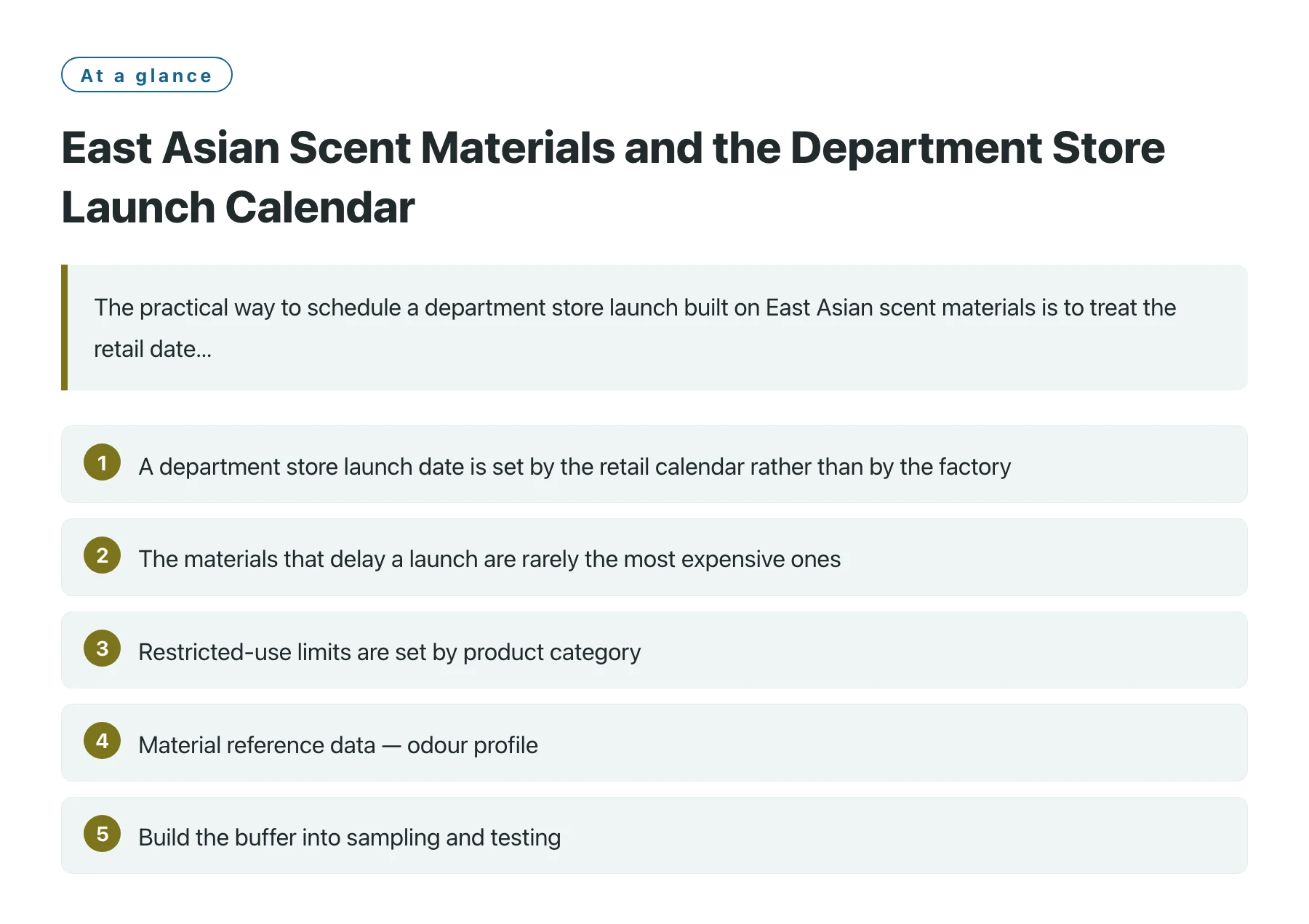
Key takeawaysA department store launch date is set by the retail calendar rather than by the factory, so the plan has to be built backwards from the counter instead of forwards from the brief. · The materials that delay a launch are rarely the most expensive ones; they are the ones that need approval paperwork, a stability check in the final base, or a harvest window. · Restricted-use limits are set by product category, so the same East Asian accord that clears a fine fragrance may need adjusting before it can go into a body lotion or hand cream [1]. · Material reference data — odour profile, tenacity and typical usage levels — is worth confirming before the brief is written rather than after the first sample round [2]. · Build the buffer into sampling and testing, not into bulk production: a fortnight saved before approval is worth more than a fortnight saved at the end.
A department store buyer works to a calendar that has nothing to do with how a fragrance is made. The counter date is agreed with the retailer, the marketing for the range is built around it, and the sell-in window takes the goods out of the brand's hands well before the public sees them. By the time the perfume is being developed, the honest question is not how long development takes, but which parts of it can move and which parts cannot.
East Asian materials deserve separate attention here because they are uneven. Some are commodity ingredients with deep supply. Others — absolutes, particular teas, region-linked botanicals — arrive with documentation, batch variation and, in some cases, a seasonal purchase window. Treating the whole palette as a single line item is what produces a schedule that works on paper and slips in practice.
This is a working view of where the calendar goes on a department store launch, and where East Asian materials change the arithmetic. It is written for the person who has to hold the counter date and the material list in the same hand.
Where the calendar actually goes
| Stage | What it involves for an East Asian palette | Where weeks are won or lost |
|---|---|---|
| Material and format selection | Deciding which naturals and synthetics carry the palette, and which of them carry use limits in the products being launched | Won early. A substitution decided in week one costs nothing; the same substitution after approval costs a sample round. |
| Material sourcing and documentation | Securing raw materials, including season-dependent naturals, and collecting the paperwork a retail buyer will eventually request | Lost when a natural is assumed to be available and turns out to be a seasonal purchase with a fixed buying window. |
| Formula development and selection | Building the accord, testing it on blotters and in the intended base, and choosing among candidate directions | Lost when the brief keeps moving between rounds, which resets the clock without anyone noticing. |
| Compatibility and stability work | Holding the filled product at temperature and checking it against the packaging that will actually ship | Lost when testing is scheduled after packaging is locked and a failure forces a late change of liner, pump or coating. |
| Restricted-use and labelling review | Checking every category in the range against the limits that apply to it, then preparing the labelling inputs [1] | Won when it runs in parallel with development; lost when it runs after sampling and a material has to be reduced. |
| Bulk compounding and filling | Producing the batch, filling it, and retaining a reference from the approved material | Rarely the slow part. When this stage slips, it is usually because documentation or packaging arrived late. |
| Decoration, assembly and dispatch | Decorating bottles, assembling gift and travel formats, and moving goods into the sell-in window | Lost when decoration capacity is booked late, especially in the weeks before a retail season. |
The pattern in that table is worth stating plainly: the stages that lose the most time are the ones waiting on a decision or a document, not the ones waiting on a machine.
Where East Asian materials change the schedule
Material lists are usually drawn up for scent reasons first and sourcing reasons second, which is the correct order for the creative work and the wrong order for the calendar. The two questions that belong beside every proposed material are how long it takes to obtain in production quantity, and what documentation travels with it.
There is also a practical difference between a material that is merely expensive and one that is genuinely awkward. Expensive materials mostly affect the cost sheet. Awkward materials affect the timeline, the testing plan and sometimes the market the product can be sold into.
Naturals, absolutes and the approval trail
An osmanthus absolute, a jasmine absolute or a specific tea accord is not ordered the way a synthetic is ordered. Batches vary, the vendor may be a single source, and the material may need an extra confirmation step before it goes into a bulk compound. The sensible response is not to avoid these materials — a palette built on osmanthus and tea notes is often the reason a range reads as East Asian rather than generic — but to give them a longer runway and to confirm the reference material before the brief is finalised [2].
Use limits matter just as much as availability. A material can be perfectly legal in a fine fragrance and restricted in an aerosol, a body lotion or a product aimed at children, and the limits apply per category rather than per brand [1]. A palette that is checked against the whole range at the start rarely needs to be reworked later, which is precisely why the check belongs early despite feeling like a detail.
Season, availability and substitution
Some East Asian materials are tied to a harvest or a limited production run, and no amount of project management changes that. The workable approach is to identify a qualified substitute before the first sample is approved, so that a shortfall becomes a documented swap rather than a development restart. Names are cheap to change in a brief and expensive to change in a filling line.
Working backwards from a counter date
Building backwards from a retail date is not difficult; the difficulty is resisting the temptation to protect the date by shortening the stages that fail quietly. Sampling and stability work are the two stages most often compressed, and both are the reason a bulk order can arrive smelling subtly different from the approved sample.
A useful discipline is to write the schedule with the approval step in the middle and two separate buffers on either side of it. The first buffer protects the decision-making; the second protects testing and packaging. Collapsing both into a single buffer at the end hides which side of the project is actually late, and it is exactly what happens when a brand negotiates only the delivery date.
Decisions to fix in week one
Format and concentration, the number of products in the range, the markets the range will be sold in, and the position of the scent within the brand's existing line are all decisions that other stages depend on. Each one left open keeps a material unconfirmed. A buyer who has settled them is not being bureaucratic; they are removing the most common cause of a moving deadline, and a Chinese fragrance house will normally say so during the first briefing call.
Where the buffer can still help
Buffer placed before bulk production is the only buffer that can be used. Once the batch is compounded, the remaining options are cosmetic and expensive. Placing the slack in the week between selection and stability testing, and again between approval and the bulk instruction, gives the project room to absorb a failed test or a late material without touching the counter date.
If the schedule has to be compressed, compress the number of competing development directions rather than the testing plan. Fewer directions, each developed properly, usually reach a counter faster than five options that each skip a compatibility check. A partner that handles fragrance R&D and production under one roof is also worth weighing, because every handover between separate companies is a place where a week disappears without appearing on any plan; that is the kind of scope a factory that handles fragrance R&D and production can set out in a single conversation.
Sources
- IFRA Standards Library (International Fragrance Association) —— The IFRA Standards Library lists the restrictions the fragrance industry applies to individual fragrance ingredients, based on safety assessments; it is the reference point for compliant fragrance formulation.
- The Good Scents Company —— A reference database of aroma materials with odour descriptions, CAS numbers and typical usage information.
Frequently asked questions
How long before a department store launch should fragrance development start?
It depends on the range, but the reliable way to answer is to sequence the work rather than to name a number of months. Development, selection, compatibility and stability testing, restricted-use review and bulk production all need to happen between the brief and the counter, and packaging adds its own queue. Once each stage has a duration attached, the start date falls out of the counter date instead of being guessed.
Do East Asian scent materials take longer to source than other materials?
Not as a group. Commodity materials move quickly; absolutes, single-source naturals and season-linked botanicals are the ones that need a longer runway and a qualified substitute identified in advance. The practical step is to ask, material by material, how it is purchased and how long a replacement would take.
Can a launch date be protected without reducing the number of products in a range?
Sometimes, but the range size is one of the few variables that genuinely buys calendar time. Every additional product base — a lotion, a body mist, a hand cream — adds its own compatibility and stability combination and its own labelling check. Reducing the range is usually more effective than asking a factory to shorten a test.
When should restricted-use limits be checked for a new palette?
Before the candidate directions are chosen, if possible. Limits depend on the product category, and a material that fits a fine fragrance may not fit an aerosol or a leave-on body product in the same range. Checking early costs a conversation; checking late can cost a reformulation during the sample round.
What should a brand bring to a first scheduling conversation with a factory?
The counter date or sell-in window, the product formats, the markets the range will be sold in, and a draft material direction. With those four, a development team can name the stages that will decide the date and say which decisions have to be made first.